
NYC Property Tax Records
New York City property tax records cover more than one million parcels across five boroughs. The NYC Department of Finance handles all assessments and tax billing for Manhattan, Brooklyn, Queens, the Bronx, and Staten Island. You can search property tax records for free through ACRIS and the DOF online portals. These tools let you pull up assessed values, tax bills, ownership history, and recorded documents from 1966 to the present. Each borough uses the same city system, though Staten Island land records have some differences worth noting.
New York City Overview
NYC Department of Finance Property Tax Records
The NYC Department of Finance values every property in the city each year. This is the first step in setting your tax bill. The DOF publishes a tentative assessment roll in January and a final roll in May. You can look up any parcel by address or by its Borough-Block-Lot number. The search is free and runs around the clock.
NYC uses four tax classes. Class 1 covers one to three family homes. Those get assessed at 6% of market value, with caps that limit how fast the assessed value can rise. Class 2 is for rental buildings, co-ops, and condos, assessed at 45% of market value. Class 3 is for utility properties. Class 4 handles commercial and industrial parcels, also at 45%. Tax rates for recent years show Class 1 at 21.167%, Class 2 at 12.473%, Class 3 at 12.536%, and Class 4 at 10.694%. These rates shift each fiscal year based on the budget.
Every property owner gets a Notice of Property Value each year. That notice tells you your new assessed value and estimated market value. If you think the number is wrong, you have the right to challenge it. The DOF main office is at 66 John Street, New York, NY 10008. You can call (212) 504-4080 for general questions.
Search NYC Property Tax Records Through ACRIS
The Automated City Register Information System is the main tool for searching NYC property records. ACRIS lets you find deeds, mortgages, liens, and other recorded documents for Manhattan, Brooklyn, Queens, and the Bronx. Records go back to 1966. You do not need to register. Just type in an address or BBL number and start searching.
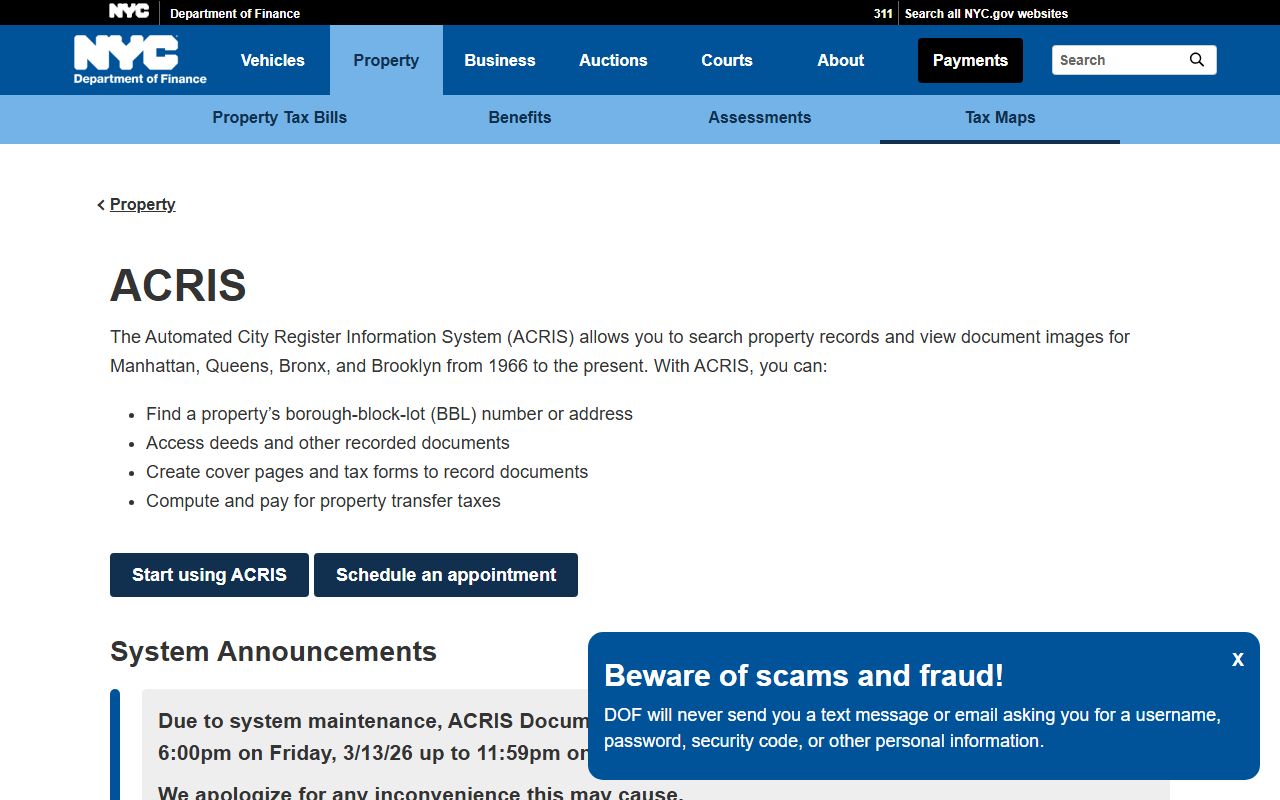
ACRIS also handles electronic filing. All Real Property Transfer Tax returns must go through ACRIS now, even for Staten Island. The system has six main functions: search records, find parcels, apply for exemptions, create tax forms, calculate fees, and access data services. Most people use it to search by address or party name. You can find documents tied to individuals, LLCs, or corporations.
Keep in mind that ACRIS may be down for maintenance on weekends, usually from Friday at 6 PM to Sunday at midnight. PDFs uploaded to ACRIS get converted to images for the public record. The system works best with clear black-and-white scans under 11 by 17 inches. If you need help, the ACRIS Contact Center is at (212) 487-6300 or acrishelp@finance.nyc.gov.
Note: Staten Island historical land records are not in ACRIS and must be searched through the Richmond County Clerk.
NYC Property Tax Bills and Payments
You can view and pay your property tax bill through the DOF online portal. Search by address or BBL to see current charges, past payments, and any outstanding balance. Most NYC properties pay taxes in four quarterly installments. The site shows billing amounts and due dates for each quarter.
If you fall behind on taxes, the city may place a lien on your property. The annual tax lien sale puts delinquent properties up for lien auction. You can check the pre-sale list online to see which parcels are at risk. A redemption period gives owners time to pay before the lien transfers. For questions about delinquent taxes, call the Finance Department at (212) 639-9675 or visit One Centre Street, 22nd Floor.
Property Tax Exemptions in New York City
NYC offers several programs to cut your tax bill. The STAR program lowers school taxes for owner-occupied homes. Basic STAR is open to all owners. Enhanced STAR adds a bigger break for seniors 65 and older with income under the state cap. You can apply online through ACRIS or through your local assessor.
Veterans get their own exemptions. Under RPTL Section 458-a, the amount depends on your service record and disability status. Senior citizens with limited income may qualify under RPTL Section 467 for a sliding-scale reduction. Disabled homeowners and clergy have separate programs too. All exemption forms are on the DOF property forms page. Most can be filed online or in person at a borough business center.
The city also runs abatement programs for certain property types. Co-op and condo owners may qualify for an abatement that offsets part of the higher Class 2 assessment. Check the DOF site for current program details and deadlines.
NYC Assessment Appeals Process
If your assessed value seems too high, you can challenge it through the NYC Tax Commission. This is an independent city agency that hears appeals. There is no filing fee. The deadline for Class 2, 3, and 4 properties is March 1 each year. Class 1 owners have until March 15.
You can file in person or by mail. The Manhattan office is at One Centre Street, Room 2400. The Bronx Business Center sits at 3030 Third Avenue, 2nd Floor. All appeal forms are online. The Tax Commission reviews your evidence and makes a decision before the final roll comes out in May. Your assessment can go down or stay the same. It will not go up because of your appeal.
Borough Office Locations for NYC Property Tax Records
The Department of Finance runs offices in each borough for in-person services. These are the ACRIS filing and records offices:
- Bronx: 3030 3rd Ave, 2nd Floor, Bronx, NY 10455
- Brooklyn (Kings County): 210 Joralemon Street, 2nd Floor, Brooklyn, NY 11201
- Manhattan (New York County): 66 John Street, 13th Floor, New York, NY 10038
- Queens: 144-06 94th Avenue, Jamaica, Queens, NY 11435
- Staten Island (Richmond County): Records through Richmond County Clerk
Each borough also has its own county page with more details on local property tax records. NYC spans five counties: Kings County for Brooklyn, Queens County, New York County for Manhattan, Bronx County, and Richmond County for Staten Island. The property tax system works the same way across all five, but the clerk offices handle land records separately.
NYC Real Property Transfer Tax
When property changes hands in New York City, the buyer or seller files a Real Property Transfer Tax return. All RPTT filings now go through ACRIS. The tax rate depends on the property type and sale price. Forms and calculators are on the DOF website. For Staten Island, you must file both through ACRIS and on paper with the Richmond County Clerk.
Transfer reports also feed into the statewide SalesWeb database run by ORPTS. However, NYC sales data is handled separately through ACRIS rather than the state system. You can download assessment roll data files from the DOF site too. The FY27 database covers all four tax classes and runs over 120 megabytes for the full set.
State Resources for NYC Property Tax Records
The Office of Real Property Tax Services at the state level provides oversight for all property tax administration in New York. While NYC runs its own assessment system, state law still applies. RPTL Section 300 says all real property is subject to tax unless exempt. RPTL Section 305 requires uniform rates within each jurisdiction. These rules govern how the DOF sets rates across the four tax classes.
The NYS Tax Data Portal tracks property tax trends statewide. NYC is the largest single property tax market in the state. The city's levy makes up a big share of the statewide total, which hit $74.54 billion in 2025. For questions about state programs like STAR, call the state at 518-591-5232.
Nearby Cities
Looking for property tax records in cities near New York City? These pages may help: